WHY WRITE????
Creative Inspiration from Grandpa Bartels

In case you missed it on my social media posts, I recently had my first foray into radio storytelling, sharing my lifelong source of writing inspiration with Wisconsin Life on Wisconsin Public Radio.
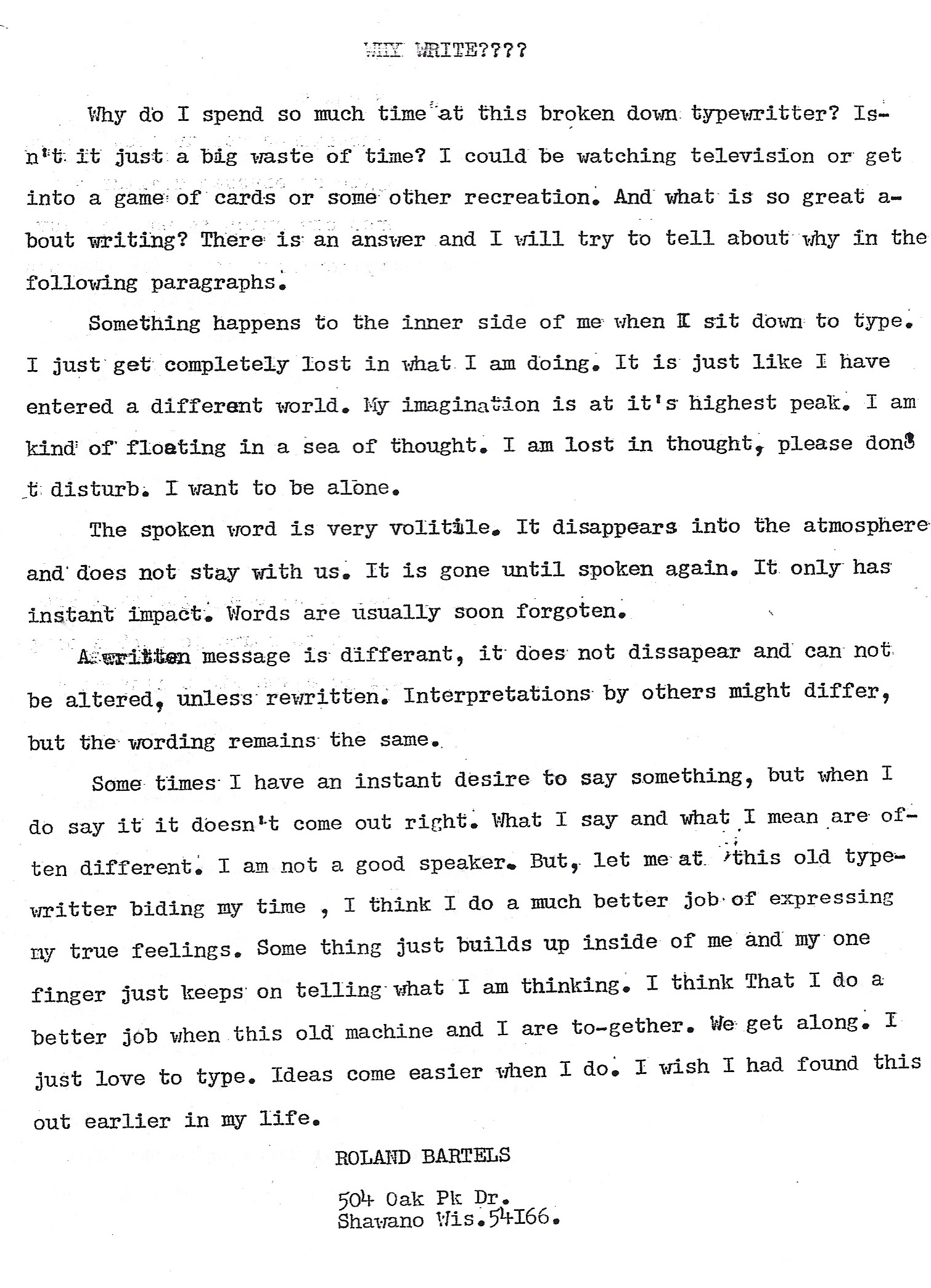
Roland Bartels, aka Grandpa Bartels, will always remain on my Mt. Rushmore of literary influences. And the story behind his now famous one-page letter, titled “WHY WRITE????” is a revealing screed for anyone seeking affirmation or inspiration on the written word and our levels of creative encouragement.
In case you missed the recent WPR post, I wanted to share the full essay with all of you, along with some extra credit images and content surrounding Grandpa Bartels and his legacy.
Hope you enjoy.
WHY WRITE????
Ask any writer to tell you their influences and you will hear the great names passed around. Joan Didion. John Steinbeck. Toni Morrison. While these writers continue to impress me with their words, the most influential writer I have ever known never had a New York Times bestseller, but easily carried a more distinguished title: Grandpa.
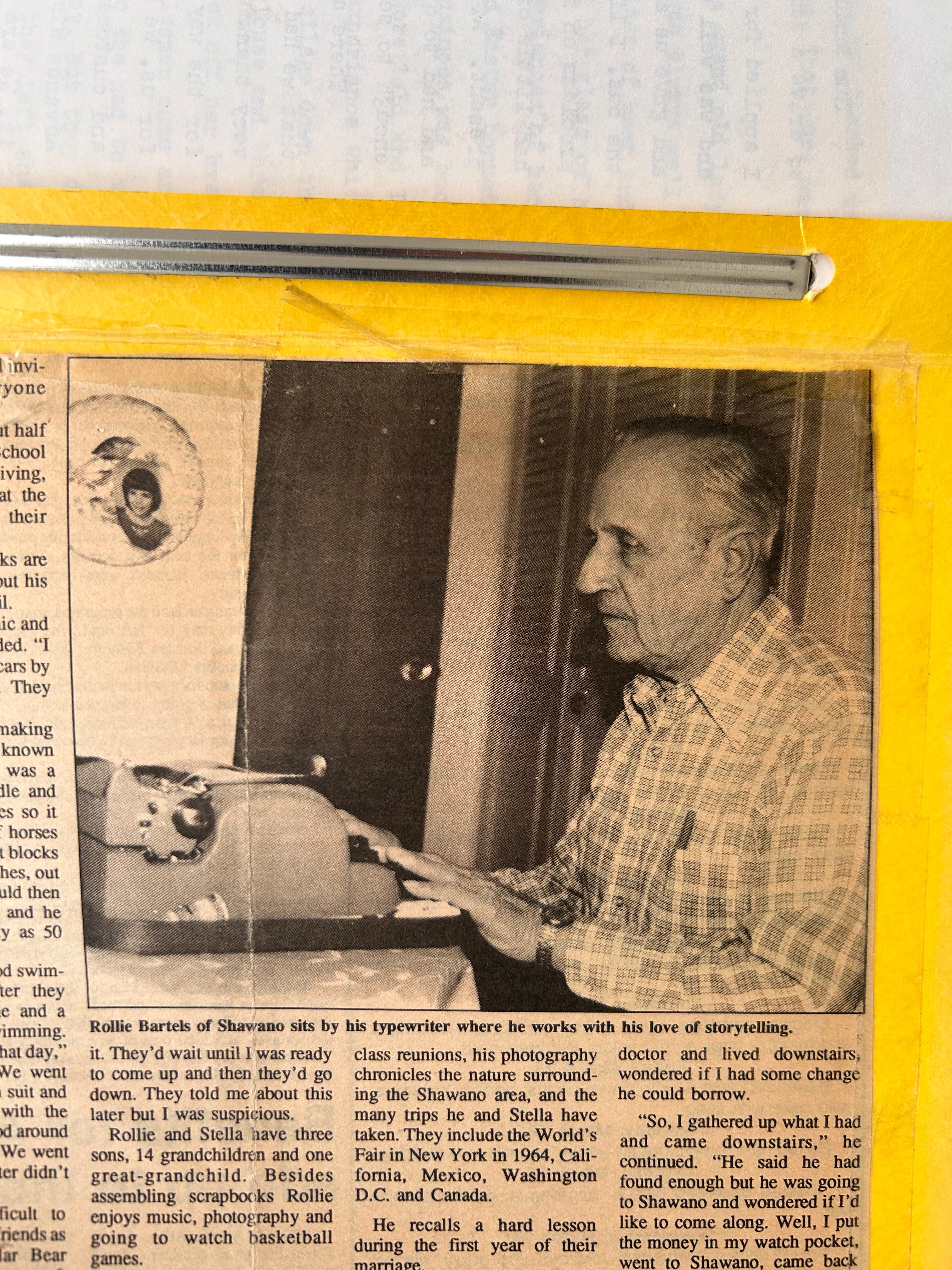
When my grandfather, Roland Bartels, retired in the early 1980s, he decided he did not want to sit and watch television every day. Most men in Rollie’s small Wisconsin hometown of Shawano talked about hunting, fishing and the Green Bay Packers. So he decided to challenge his comfort zone and try a local writing class, consisting of the teacher, six other local women, and himself.
THE LEGEND OF THE ONE-FINGERED WRITER
Rollie suffered from arthritis, and his hands often shook. Since couldn’t write longhand very well, he figured he could type if the opportunity presented itself. So my grandmother purchased a typewriter for him from St. Vincent’s, and at seventy-two-years years young Grandpa Bartels became a writer.
Rollie made the written word a priority in his daily life. He typed one finger at a time, one page a day, and he enjoyed the challenge of capturing the world on that single page, harboring one simple objective: fill the page with a topic important to you, and that’s a day well spent wondering about the world.
Usually it was his right index finger, but on days where he was particularly excited to get his words on the page (something writers all experience to varying degrees today) he would apply both index fingers to capture his beliefs. I remember visiting my grandparents and hearing the click…clack…(time)…click…(time)…clack… coming from their bedroom, which is where he wrote, a small desk at the foot of their bed, next to a sunny window with thin white curtains.
His writing was honest, confrontational and sincere, embodying curiosities of the world at large and, more specifically, his neighborhood community. Eventually he started submitting articles to the local Shawano newspaper and received many publications. Many of his articles reflected a voice of unending curiosity toward the world:
“Why does the world act this way?”
“Who did this person at the Post Office budging in line think they were?”
“Where’s the best Wisconsin fish fry on a Friday evening?”
The one-finger-typed letters harbor grammatical and physical errors, which I often remark celebrates their uniqueness, since I feel that mistakes are beautiful. It reminds us that nothing – from the first words to the final sentiment – is ever going to be perfect, but it is uniquely ours. I am one of those freaks who celebrate seeing typos in a hardcover first edition print. It’s a refreshing reminder human beings still get the first and last laugh at computers and technology simply by being fallible.
I also speak from experience when I say it can sometimes be very challenging to capture full sentiment in approximately 250 words.
THE BLANK PAGE
For writers, inspiration comes in many forms. There are hundreds of excuses to not write. But why do we write? Some say they feel most like themselves when writing. Andrea Gibson wrote to remember, to heal, and to let the air in. Nicole Krauss says it never comes out clear enough when we speak, so writing provides the ideal translation. Paulo Coehlo writes as a way to try turning sadness into longing.
If “Why Write????” is beneficial for anyone, I hope it inspires people who often found the blank page as too adversarial. His words should arrive to encourage the unique voice we all have in our writing. “I am kind of floating in a sea of thought,” he says. He was using his daydreams to conjure the right sentiment. The time spent facing the blank page and working at his typewriter was sacred, which is why he carved out the daily exercise, something any dedicated writer understands.
We exist in a fragile literary time. I still enjoy writing more than anything in this world, but does everyone who used to love writing still enjoy that as much as they did yesterday? We’re only subjected to more distractions with each passing moment. I tuck away and find time to write whenever I can, or whenever I need to form sentences on pages with my thoughts. I am still that nineteen-year-old kid, watching the world unfold before my eyes, happy to start a sentence halfway, then cross it out or delete it, breathe, think, then begin again. The process is invigorating. I still love the warm morning sun effects of beginning a new story; still savor the daily afternoon breezes I get after finishing a protein-healthy sentence; still worship the illustrious, comforting moon when it appears over some well-constructed paragraphs.
There is no hidden meaning to approaching the blank page, and most writers understand the weight of what awaits them across those empty lines and pages.
Stephen King’s On Writing calls the act anything but mild:
“You can approach the act of writing with nervousness, excitement, hopefulness or even despair – the sense that you can never completely put on the page what’s in your mind and heart. You can come to the act with your fists clenched and your eyes narrow, ready to kick ass and take down names. You can come to it because you want a girl to marry you or because you want to change the world. Come to it any way but lightly. Let me say it again: you must not come lightly to the blank page.”
Anne Lamott’s holistic Bird By Bird captures the inspiration of what some of us are lucky enough to find early in life: our family. “Ever since I was a little kid,” she writes, “I’ve thought that there was something noble and mysterious about writing, about the people who could do it well, who could create a world as if they were little gods or sorcerers.”
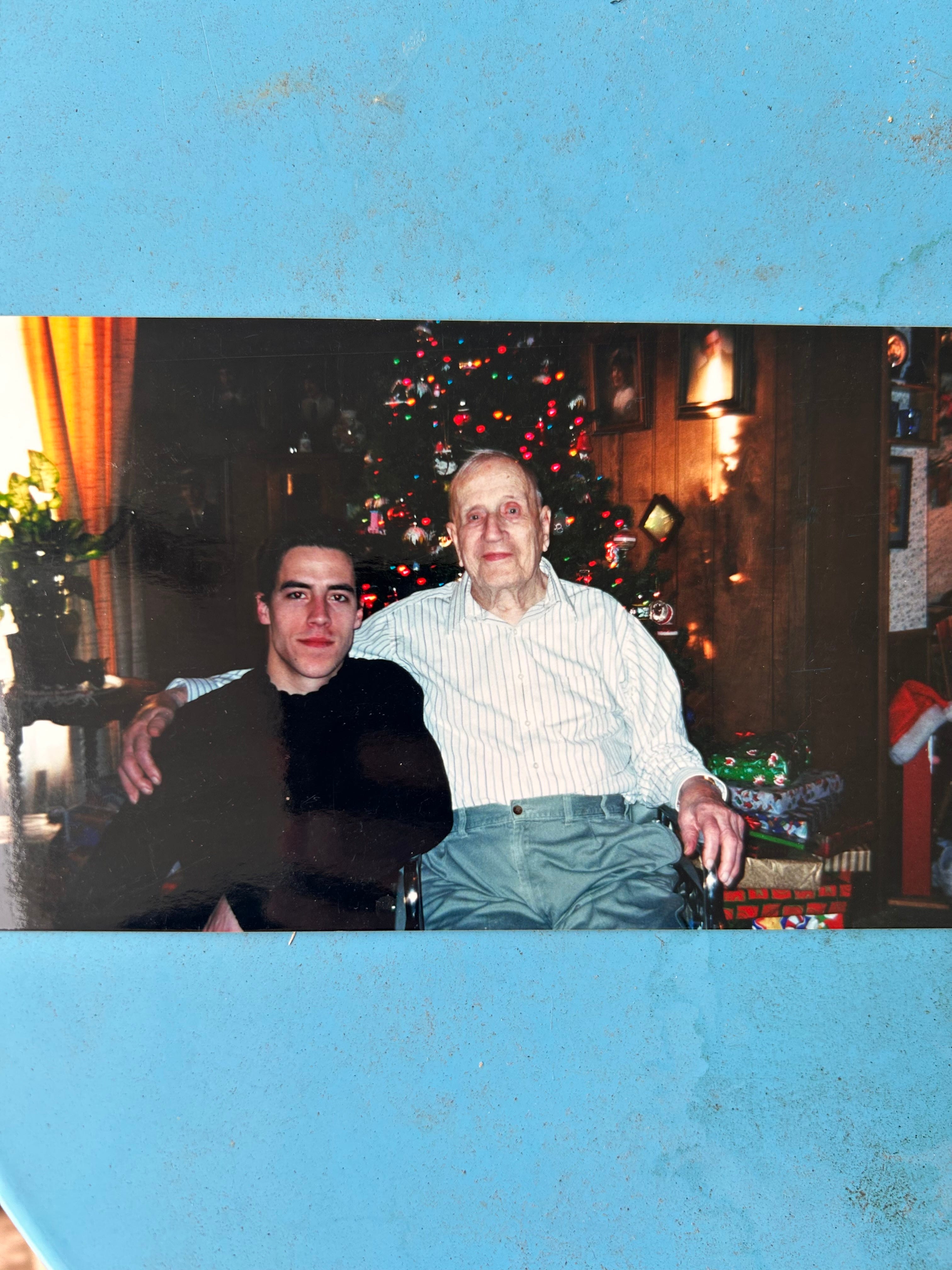
If you ever have the chance to drop by Joseph Leonard, a cozy restaurant in the heart of New York’s Greenwich Village with many Wisconsin ties, you will find where the legacy of Grandpa Bartels really continues through to this day. Joseph Leonard was named after my dear friend Gabriel Stulman’s two grandfathers, Joseph and Leonard. Throughout the intimate West Village restaurant there are framed photos of grandfathers connected to the people who helped Joseph Leonard become a wonderful neighborhood restaurant. When we opened, I didn’t have a framed photo of my grandfather – who had passed away six years earlier – but I had many pages of inspiring letters, poems and musings on the world, and I had been collecting his letters as inspiration for my own writing.

Gabriel was so touched when he read my grandfather’s “Why Write????” he wanted to frame it and hang it somewhere everyone could see it.
We ended up hanging it in the bathroom.
“WHY WRITE????” became so popular we had to reconsider how to share it with everyone, as people were repeatedly happy to steal the framed copy on the wall. So we made copies with a sign attached to the letter, saying “Copies Available at Bar,” and eventually, we made the letter into postcards we handed out as check presenters, and the response was quite overwhelming. Diners were always asking about the letter. “Who wrote that?” “Who was that writer?” “Did he have a connection to this restaurant?”
“Why Write????” was a conversation stimulant for people attending the restaurant, offering me a chance to speak about my grandpa as though he were still living larger than life, and share a little of his story. Even certain celebrities, like Robin Wright of The Princess Bride, asked for copies, inspired by the letter’s genuine sentiment. The domino effect of his letters achieved something he never imagined when writing down his thoughts: his words lived on, and were connecting to other artists, igniting their own artistic creativity. Musicians, actors, painters and other writers commented on how influential “Why Write????” connected with them, informing me they keep Grandpa Bartels’ message posted on their fridge, or framed in their own homes (some even all the way across the ocean in Europe) and above their writing table, as reminders of why we aim to create stories with words.
Grandpa Bartels’ “Why Write????” captures one person’s musings on the creative possibilities surrounding their daily life, ruminating over reasons why writers attempt to form words in the first place. “Why Write????” takes one blank page and reflects on what the writer has seen, heard, and believed to be true, even if it is conjured from the imagination.
To this day, whenever I read it I get goose bumps before finishing the letter.
Reading Grandpa Bartels’ writing was like listening to Sam Cooke on vinyl; there’s just so much heart and soul bursting out with every line. His words took on the voice of our favorite poets: observational, curious, and most of all, truthful.
If “Why Write????” is beneficial for anyone, I hope it inspires people who often found the blank page as too adversarial. His words should arrive to encourage the unique voice we all have in our writing. “I am kind of floating in a sea of thought,” he says. He was using his daydreams to conjure the right sentiment. The time spent facing the blank page and working at his typewriter was sacred, which is why he carved out the daily exercise, something any dedicated writer understands.
My grandfather loved words the way I hope you love words; he discovered them on his own terms and used what he could find to craft an ongoing wonder of our literary ecosystem. He delighted in the sounds they made inside his head, the way they unfurled as he danced across their landscapes. He was a literary hero on his own terms, the way many other people are who take to writing with the appropriate respect and discipline it warrants.
COULDA, WOULDA, SHOULDA
The act of writing is often met with its bottomless quicksand of distractions. (There’s always more peanut butter in the cupboard and a spoon with my name on it.) And sorry to sound like a 1970s country singer, but sometimes the only payoff can often be a sore lower back, cramped muscles and a bitter realization you really need to clean the kitchen, pay bills, or actually put on clothes and get fresh air.
I have other letters framed and posted from Grandpa Bartels, ruminations on a life of a person being reflective, of a time in a person’s day where they captured moments of contemplative wonder. They are stories of living in small town America, stories of our family, opinions on community, and poems that read like flowers growing on the page. They are just as invaluable as my Amy Hempel short stories, my Charles Baxter essays, my dog-eared copy of The Collected Works of Billy the Kid by Michael Ondaatje.


If I am ever weary or losing focus on a writing assignment, or challenged by the rigor and distractions of daily life, I think of my grandpa at his tiny writing desk. Stories are bridges, and writers are the engineers responsible for the blueprints of their design.
The end of Grandpa Bartels’ lovely one-page manifesto is a reflective nod to those special connections we find and appreciate as we maneuver through the legacy of our time on earth. “I just love putting words on paper,” he says. “I wish I found this out earlier in life.”
Whether it’s a little notebook you carry in your back pocket, or a sheet of paper with a pen next to your bed, or even the audio recording on your smart phone, make time to capture the words churning inside your head. We are so lucky to find these opportunities while living inside a world asking for our attention every moment of every waking day. Make time to find the opportunity to put your own thoughts into words. Make it for nothing more than the moments you coulda, woulda, shoulda, and fill that blank page with some soulful contemplation, because the world is waiting for what you have to say.
Make it last as long as you can.
I hope you find some joy and inspiration from his letter for your own writing.